

One proposal offers a customer-support team. Another promises to manage customer-support delivery. Both may include agents, supervisors, reporting, and technology. The labels alone do not tell you which decisions remain with your business or who fixes a recurring problem.
When comparing BPO vs managed services, start with the work you need done and the responsibility you expect the provider to take. A useful comparison turns those expectations into a service scope, an operating model, and evidence you can review before signing.
What do BPO and managed services mean?
Business process outsourcing (BPO) means contracting an external service provider to perform a business function or process. That can include customer-facing work, such as support, as well as back-office work. IBM's BPO overview describes both categories.
Managed services generally describes an arrangement in which a provider takes ongoing responsibility for an agreed service, often including its day-to-day operation and performance management. The term is common in IT, but it is also used beyond IT. For example, Deloitte's public-sector managed-services paper discusses a broader range of functions and the responsibilities an organization retains.
These descriptions can overlap. A BPO provider may manage an outsourced process, supervise the people delivering it, and work to agreed performance measures. Calling that arrangement BPO does not establish that it is short-term, limited to repetitive work, or paid only by headcount.
Similarly, “managed” does not mean the provider owns every business decision. Your company may still control refund policy, product changes, security requirements, and spending approvals. The service agreement must explain how those retained decisions interact with the provider's responsibilities.
If you are searching for managed services vs outsourcing, treat the terms as a starting point for questions. Outsourcing describes using an external party; the managed-service description adds an expectation about ongoing management. The proposal needs to show exactly what that management includes.
How do scope and accountability differ in practice?
Compare the scope of work first. A name such as “customer-service outsourcing” can cover very different arrangements: overflow calls, a dedicated support queue, or a broader operation with staffing, training, and quality reviews.
The table below illustrates two possible arrangements. They are comparison examples, not fixed definitions of BPO and managed services.
| Dimension | Buyer directs more of the operation | Provider manages more of the operation |
|---|---|---|
| Daily work | The buyer supplies detailed tasks, procedures, and priorities. | The provider organizes delivery within the agreed scope. |
| Staffing and supervision | The buyer may retain scheduling or direct operational oversight. | The provider may own scheduling, supervision, and coverage planning. |
| Quality review | The buyer may run reviews and specify corrective action. | The provider may run reviews and propose corrective action against agreed criteria. |
| Service changes | The buyer designs changes and asks the provider to implement them. | The provider may identify changes, with approval rules for their implementation. |
| Business policies | The buyer retains decisions assigned to it. | The buyer still retains decisions assigned to it. |
| Exit and handover | Records and knowledge need a defined transfer process. | Records and knowledge still need a defined transfer process. |
Both arrangements can appear in BPO contracts. Either may include elements described as managed services. Use the table to identify responsibility, rather than forcing a supplier into a category.
Process ownership is especially important when a problem crosses departments. Suppose an agent can explain a replacement policy but only your operations team can authorize a shipment. The provider can own the explanation, documentation, and escalation. Your company still needs an owner for the approval and fulfillment steps.
Write those retained responsibilities alongside the provider's responsibilities. Accountability becomes easier to assess when the handoff has an owner, required information, and an agreed next step. “End-to-end support” is too vague to settle those details on its own.
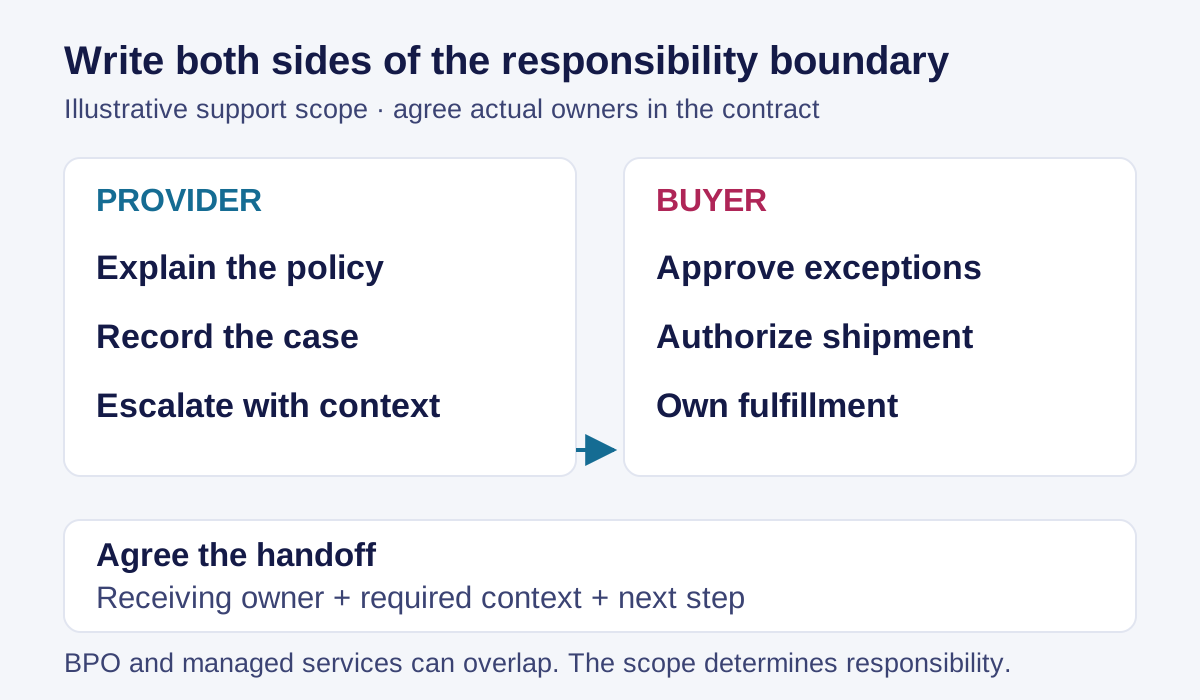
Illustrative responsibility split for a replacement request. Agree the actual owners; neither service label settles the boundary by itself.
How should you compare pricing and service levels?
A pricing model does not reliably distinguish BPO from managed services. IBM describes BPO pricing structures that include fixed-price, time-and-materials, and outcome-based arrangements. Compare what each price includes and which assumptions make it valid.
Ask both suppliers to price the same service scenario. Specify contact channels, coverage hours, languages, expected workload, and the responsibilities included. Otherwise, a lower monthly fee may describe a smaller service.
| Proposal item | Question to resolve |
|---|---|
| Charging unit | Are you paying for staffing capacity, hours, transactions, a defined outcome, or a package? |
| Included management | Are supervision, scheduling, quality assurance, and training included? |
| Technology | Which licenses, usage charges, or integrations are included in the quote? |
| Volume assumptions | What workload and seasonal variation does the price assume? |
| Additional work | What triggers a change request, and how is extra work priced? |
| Transition | What does knowledge transfer, setup, and initial training require? |
| Exit | What assistance, records, and costs apply when the service ends? |
Then compare the service levels. A service-level agreement (SLA) sets agreed commitments and their conditions. A key performance indicator (KPI) is a measure used to understand performance; it may or may not carry a contractual commitment. Identify which measures have which role in each proposal.
For every promised measure, ask for its definition, data source, reporting period, and applicable exclusions. “Fast response” needs a defined channel and start point. A resolution measure needs a clear account of what counts as resolved and how repeat contact is treated.
Use a worked example from your own expected workload. Ask the provider to show how the bill and service report would be produced under that scenario. This is more informative than comparing a per-agent price with an outcome price before establishing what either purchases.
What does this mean for customer support outsourcing?
In customer support outsourcing, the central question is how people, knowledge, permissions, and follow-up work together. A trained agent can only act on the information and authority available to them.
Use this responsibility matrix to structure a provider discussion. Assign the actual owners together and include the agreed responsibilities in your service scope.
| Workstream | Responsibility to agree |
|---|---|
| Staffing | Who forecasts demand, schedules coverage, and handles absence? |
| Product knowledge | Who supplies authoritative product information, and who keeps agent guidance current? |
| Training | Who prepares material, runs practice, and decides readiness for the assigned work? |
| Quality assurance | Who defines the rubric, reviews interactions, and follows up on recurring errors? |
| Customer policy | Who approves refunds, replacements, exceptions, and changes to policy? |
| Escalation | Who accepts cases outside the first team's authority, and what context must accompany them? |
| Reporting | Who owns the definitions, checks data quality, and explains changes in results? |
Knowledge ownership deserves particular attention. If your product changes, someone must update the source material, revise the agent-facing guidance, and check that the new answer is usable. A provider cannot reliably apply a policy change that never reaches the support team.
The same applies to training. Generic communication skills are useful, but an agent handling your customers also needs your product information, tools, and escalation rules. Our guide to free call-center training resources helps distinguish general learning from preparation for a specific operation.
For a Callnovo proposal, ask which support activities, management responsibilities, and technology are included in your scope. A customer-support discussion does not establish that cloud-infrastructure administration, network operations, or other IT managed services are part of the offering.
Which arrangement fits your operating needs?
Choose an operating model around the capability your organization has and the responsibility it wants to transfer. These hypothetical situations illustrate the decision.
You have a mature support operation and need more capacity
Suppose your internal team already owns policies, forecasting, training material, and quality reviews. The immediate problem is insufficient capacity during defined hours.
A tightly scoped arrangement may fit: specify the work the external team will handle, how your managers will supervise it, and how exceptions return to your organization. Check whether your internal team actually has the time to manage that added capacity. Outsourcing the calls does not remove the retained management work.
You need someone to manage an ongoing support service
Suppose you can define the customer promises and product policies but need help organizing delivery. You may want the provider to plan coverage, supervise agents, run quality reviews, and recommend improvements.
Ask for evidence of those management processes. A sample operating report, a proposed review meeting, and an explanation of corrective-action ownership help you assess the offer. Also agree on a transition plan: what knowledge must transfer, which access is required, and how you will check readiness before handing over more work.
Your requirement is primarily IT infrastructure management
If the need is server administration, network monitoring, or recovery of infrastructure, evaluate providers against that technical scope. Customer-facing product support and IT infrastructure operations require different capabilities.
You may need separate suppliers or clearly defined teams. Ask how incidents will move between them and who keeps the affected customer informed. Do not use a broad “managed services” label as evidence that a customer-support supplier can manage the infrastructure behind your product.
Across all three situations, governance means deciding how the parties review performance, approve changes, and resolve disagreements. Make that process proportionate to the work, and name the people responsible on both sides.
What should you ask before signing?
Bring a real support scenario to the proposal discussion. Ask the provider to walk through it from first contact to closure, including an exception requiring your company's approval.
The walk-through should answer these questions:
- What is included in the service, and which work remains outside it?
- Who makes each operational decision, and which decisions return to your business?
- What are the acceptance criteria for starting the service and evaluating delivery?
- What is the reporting cadence, and which source records support the report?
- How are changes to workload, policy, or scope agreed and priced?
- What will handover include when responsibilities change or the contract ends?
Ask to see the deliverables that support the answers: a scope document, responsibility matrix, sample report, transition plan, and exit plan. Treat these as procurement questions; the final agreement needs review by the people responsible for the commercial and contractual terms.
Before choosing, test three points. Is the scope comparable? If not, align the proposals before judging price. Is every important responsibility assigned? If not, resolve the gap before transition. Can the provider show how delivery will be reviewed? If not, ask for a concrete example rather than accepting the label.
The useful outcome of a BPO vs managed services comparison is an arrangement your team can operate and evaluate. If customer support is the service you want to outsource, request a Callnovo quote with your channels, coverage needs, languages, and proposed responsibilities. Those details make the discussion specific enough to produce a meaningful scope.